
social (me)dia, myself, and I
entitlement in the internet era and our descent into solipsism.

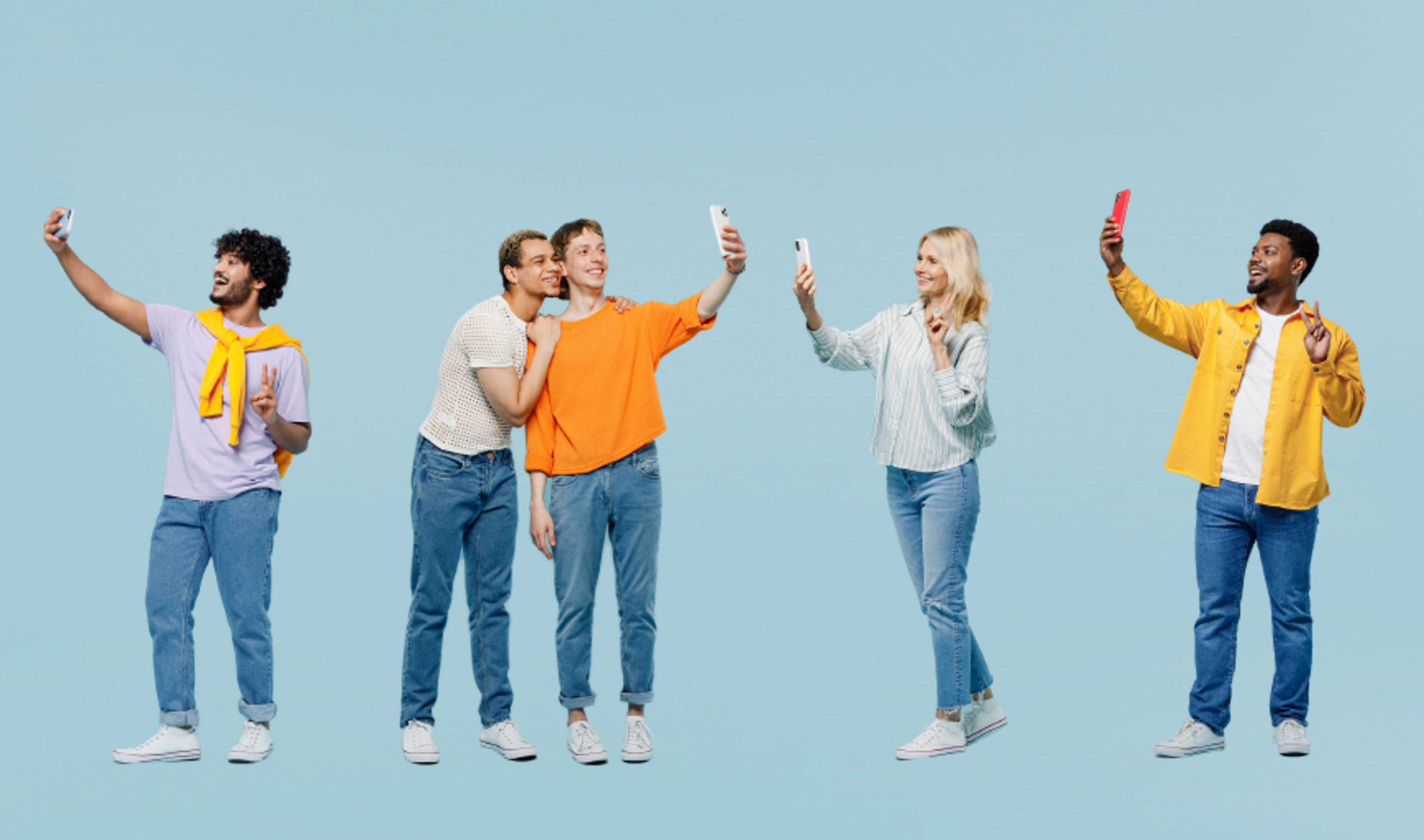
In high school, I, like many of you, had friends.
Everybody has their groups, their ride or dies, and day ones. For me, it’s been the same five guys since around 10th grade. And over the years, time has woven a tapestry of the dumbest, most insane, unforgettable memories and antics I could handle. Along the way, we've managed to ignore enough advice from each other to fill a lifetime, learning valuable lessons as we stumble and grow together.
One day, we’d have the completely novel and original thought that our lives were crazy and dramatic enough to be a sitcom. And thus our joke was born. Semesters now doubled as seasons, and like the best shows, there was drama! There were stakes dammit! Emmy bait! But more than anything, for my friends and I, it was a way to get through the highs and lows together, a reminder that no matter what happened in life, it was ultimately to progress the plot - our story.
As I entered my adult life, I realized how profoundly unoriginal my friends and I are. The “main-characterization” of oneself is a common occurrence, not just within our close-knit group but seemingly among many young individuals navigating the social landscape. We’ve all referred to our past as “lore” or spoken about our life’s events as if they’re a part of some grand storyline. It can be a fun exercise.
But while this centering of yourself in the narrative can potentially be a positive act, past this main-characterization lies a more concerning implication.
The other day while on my computer, I came across a tweet that caught my eye.
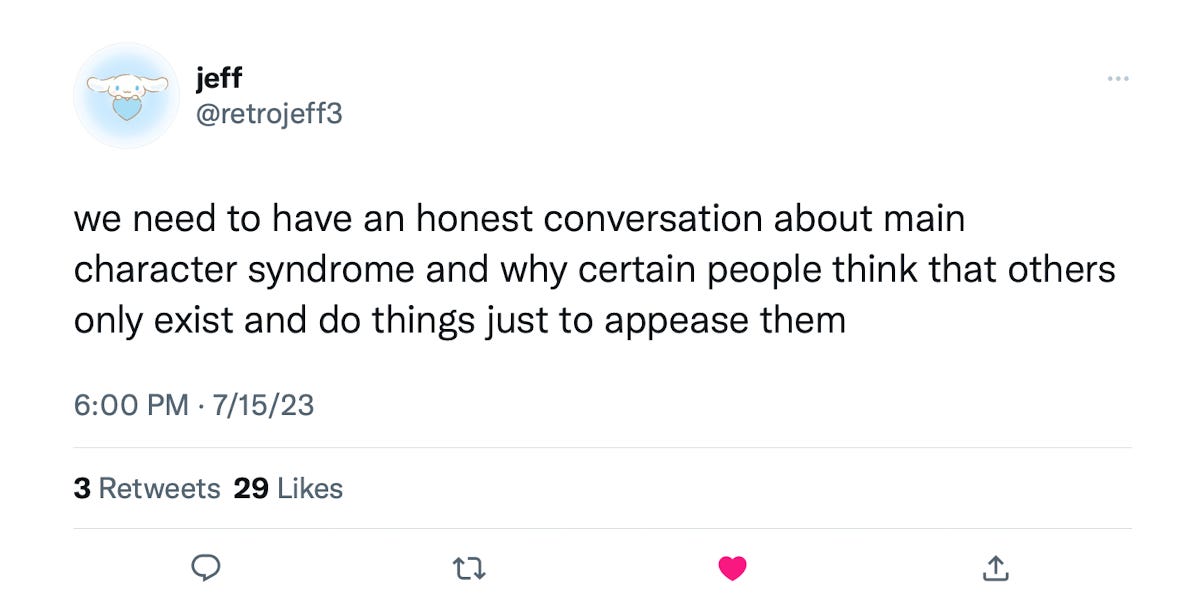
Immediately, it conjured up thoughts of this main-characterization and how it can manifest negatively. The danger lies in mistaking what should be a playful framing of our lives for a genuine belief that we are the main characters of everyone else’s stories. When the line blurs between playfulness and self-centeredness, we risk losing sight of the shared humanity that connects us all.
Especially online, there seems to be a blatant disregard for the experiences and feelings of others and a deliberate undermining of the potential for genuine understanding and empathy. To a lot of people, the internet is just a big game - they’re the player and everyone else acts as NPC, or filler to make the world more robust. More and more, people seem to forget (or ignore) that every person we encounter represents an individual with their own experiences, emotions, and perspectives.
There has to be something pushing us toward this self-centered mindset. 17th-century French philosopher, Rene Descartes came up with the concept of Cartesian skepticism as an explainer for what was provable in the world. What he concluded is that the only thing he could be sure of is the existence of himself.
Maybe we’re experiencing a kind of Cartesian doubt. Maybe we’re experiencing the inverse, where because you’re only sure of yourself, the denigration of everything and everyone else is fair game.
If you spend any amount of time on TikTok, you’ve probably seen this in action. Even at the personal level, social media is becoming more about branding. This is something the musicians on the app are acutely aware of. Videos of music snippets and the creation process can be really effective promotion for a new artist, trying to break out into an oversaturated market. But somewhere down the line “What’s the worst that can happen?” became “Is this worth the negative attention I may attract?”
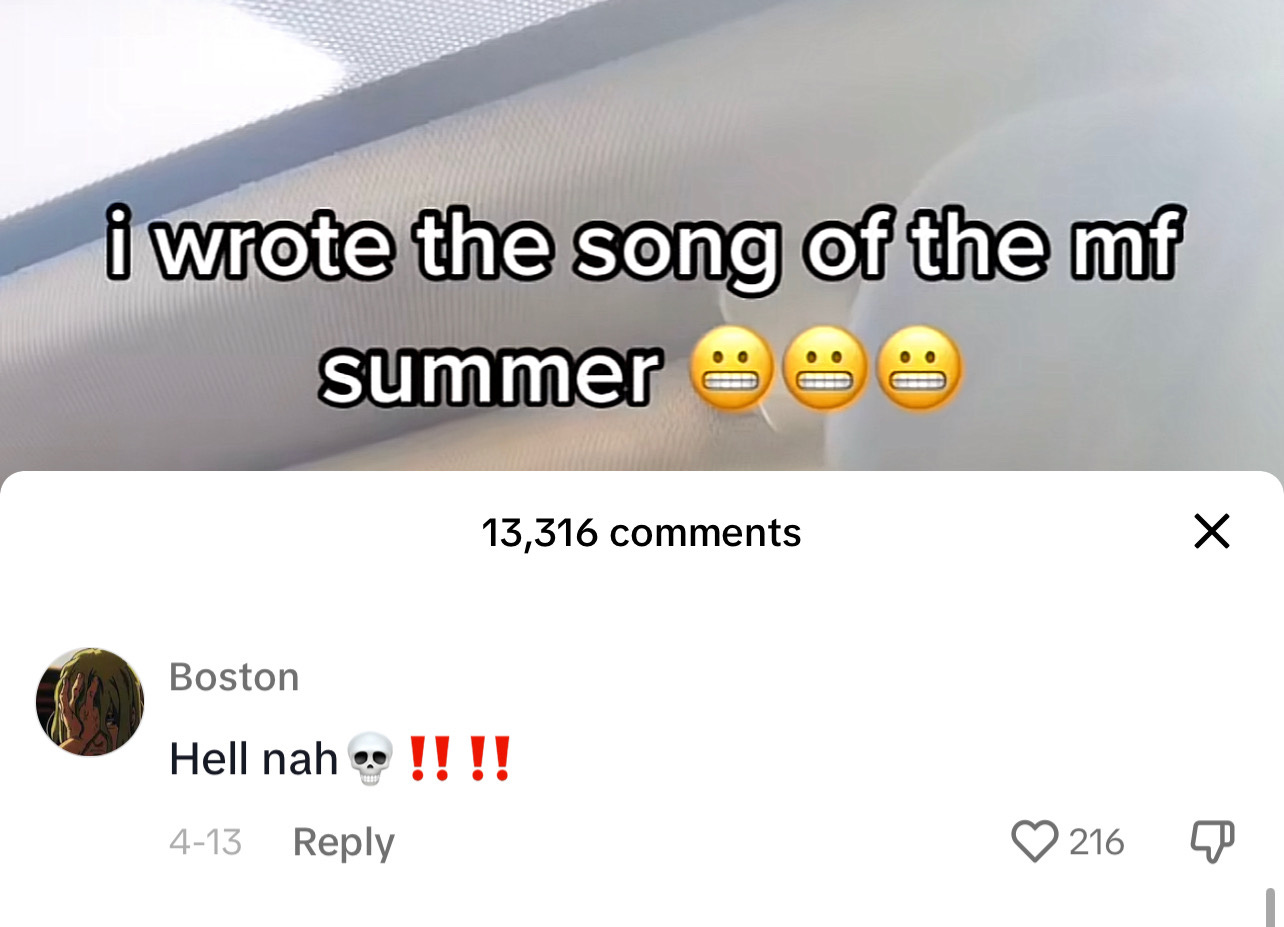
What we see is perfectly good music being decimated by hate comments; pieces of art berated by people outside the target audience. What does this do to the burgeoning artist except cause them doubt? The room for constructive criticism which could be a catalyst for improvement and growth, is suffocated amidst the barrage of negativity. Instead of receiving valuable feedback that could refine their craft, artists find themselves questioning their worth and creative choices.
No conversation about the misuse of social media is complete without a Twitter mention. Daily, tweets become battlegrounds where people are hit with personal attacks over their opinions on things like Emmy noms or where James Harden will end up next season. What starts as innocuous thoughts or interpretations of art, music, or pop culture can quickly escalate into full-blown confrontations.
This is all exacerbated by the fact that now, Twitter is essentially incentivizing users to farm for engagement. The pursuit of higher engagement metrics, such as likes and retweets, has become paramount for gaining visibility and influence. As a result, some users may resort to provocative or sensationalist content to generate reactions, further contributing to this divisive atmosphere. Twitter's structure, with tweets, retweets, and likes, creates an environment where each post becomes a performance seeking validation and recognition. The emphasis on gaining likes and retweets can drive users to prioritize self-promotion over meaningful engagement, reinforcing the belief that their opinions are the most important.
Even further, the anonymity available on the internet emboldens individuals to disregard the humanity of others and engage in behavior they may never exhibit in face-to-face interactions. Besides, the people on the other side of the screen don’t exist! Right?
In this digital arena, the focus has shifted from seeking understanding and empathizing with others' experiences to asserting oneself as the main character in a relentless quest for validation. Each tweet is a chance to perform, to amass likes and retweets, regardless of the impact on those who might be on the receiving end of derision.
It’d be irresponsible to call this solipsism, but can we say we’re moving in that direction? I think so. The more we become fixated on our own storylines, dismissing the experiences and humanity of others, the greater the divide becomes. Empathy erodes, and the space for genuine understanding and growth diminishes. The way we interact with content almost incentivizes the solipsistic worldview. Social media can undoubtedly amplify important voices and spark meaningful conversations, but the ease of sharing opinions has also given rise to a dangerous sense of entitlement. In the digital realm, where we can curate our personas and find ourselves caught deep in our echo chambers, it’s so easy to lose sight of the reality that exists beyond our screens.
And let’s be clear, this criticism is about reactions to the innocuous. There are definitely things in this world worth challenging. Hate speech, bigotry, and morally egregious positions demand a forceful response. However, we must recognize the distinction between a legitimate critique of harmful ideologies and the dismissive denigration of harmless thoughts and interpretations. Even then, attacking a position is always a more defensible position than attacking a person. Too often, the latter has become the norm in online interactions, fostering an environment where empathy and meaningful dialogue are overshadowed by a self-centered focus on one's own beliefs. Check my Twitter drafts, I love ad hominem! But my unchecked personal attacks usually result in a quick tweet and delete.
I’ll leave you with this. 17th-century poet, John Donne once wrote the following:
"No man is an island entire of itself; every man is a piece of the continent, a part of the main."
This simple yet profound statement encapsulates the essence of our shared humanity and interconnectedness. All we need is a little perspective. If life is a show, it’s one of those ones where every character has a storyline, like This is Us or Orange is the New Black or something.
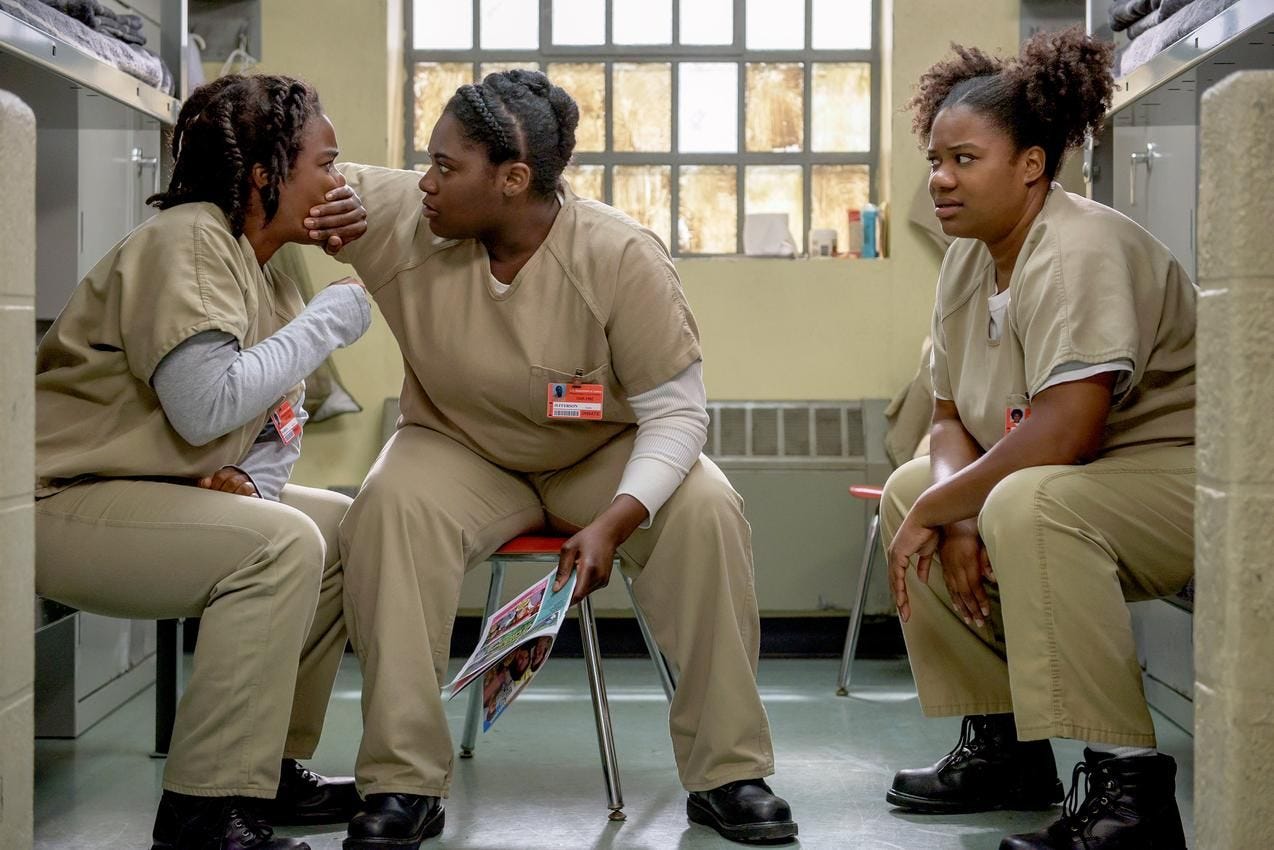
Joking aside, beyond the screens that separate us, there is a world teeming with diverse voices, waiting to be heard and understood. It may be a bit naive of me to believe we can all interact with the world in good faith, but it can’t hurt to try. Who knows? Maybe it’ll make a good show one day.
Not today though, we’re in the middle of a strike. Have some respect.
thank you for getting this far! this one was written a little differently, with less of an emphasis on a pop culture artifact, so please let me know if this is something that is working! leave a comment or tell me @holynachoes on all social media. don’t hit me on threads though. byeeeeeeee
So thoughtful & well written!!
As always... a great read!!